
The freeze response and how training can help transform it
Many people imagine that if they were ever attacked, they would immediately fight back.
In reality, that is often not what happens.
Under sudden threat, the nervous system can trigger what is known as the freeze response. Instead of running or fighting, the body momentarily shuts down.
Thoughts become slow.
Movement stalls.
People feel stuck or unable to act.
This is not weakness. It is biology.
Research in neurobiology shows that when the brain detects a threat, the amygdala, the brain’s alarm system, activates instantly. Within seconds, stress hormones such as adrenaline and cortisol flood the body. Heart rate rises, breathing becomes shallow, and blood is redirected away from higher cognitive functions.
At the same time, activity in the prefrontal cortex, the part of the brain responsible for reasoning, planning, and decision-making, drops sharply.
In other words, under acute stress the thinking brain partially shuts down.
This is why people often struggle to make decisions in dangerous moments. The body has shifted into survival mode.
Freezing is a common response for women.
Research into human stress responses suggests that the freeze response occurs in a large proportion of people during sudden threat.
Möller, A., Söndergaard, H. P., & Helström, L. (2017).
Tonic immobility during sexual assault – a common reaction predicting post-traumatic stress disorder and severe depression. Published in Acta Obstetricia et Gynecologica Scandinavica.
Key findings from the study:
• Researchers surveyed 298 women who had attended a rape trauma clinic in Sweden.
• 70% reported experiencing significant tonic immobility during the assault.
• 48% reported extreme tonic immobility, meaning they were almost completely unable to move or speak.
This study is widely referenced in trauma psychology because it demonstrates that freezing is not rare—it is a very common physiological response to overwhelming threat. Many describe feeling unable to move, speak, or resist despite wanting to.
Afterwards, survivors often say the same thing:
“I don’t know why I didn’t do anything.”
But the body did exactly what it was wired to do under overwhelming stress.
This is why training matters.
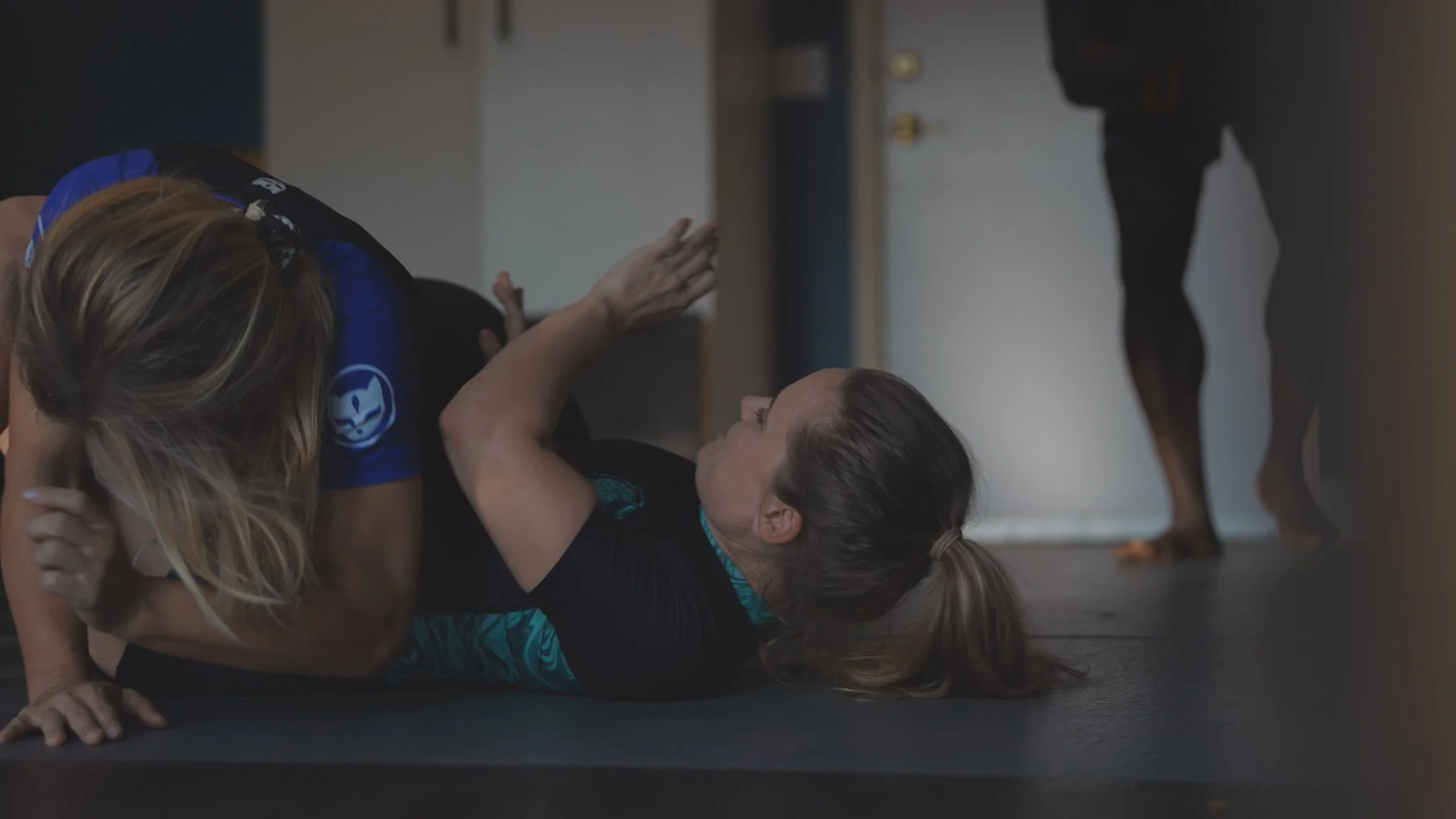
When someone repeatedly experiences controlled pressure in a training environment, the nervous system begins to adapt. The brain learns that proximity, grabbing, or sudden aggression do not have to trigger shutdown.
Through repetition, the brain begins forming faster neural pathways between recognizing a threat and responding physically.
Instead of freezing, people begin to recognize the moment and act.
This does not come from memorizing complicated techniques. It comes from:
Repetition under pressure.
Practicing simple responses.
Feeling what it is like to be grabbed.
Learning how to create space.
Learning how to move when someone is trying to control you.
Over time, the unfamiliar becomes familiar.
The nervous system becomes less overwhelmed. The brain no longer treats the moment as completely unknown.
And when that happens, the body is far more likely to respond.
That is the purpose of the Defense Labs.
Not to create perfect fighters.
But to train the nervous system so that if something happens, the response is not paralysis.
It is action.